For newly constructed logistics warehouses with heavy forklift traffic, monolithic dry-shake floor hardener is the most durable, cost-effective solution (lifetime bond, impossible to delaminate, BDT 45-75/sq ft). For existing facilities, dust-free cleanrooms, chemical storage, or spaces requiring bright aesthetic color coding, epoxy flooring is the superior system (seamless, chemical resistant, BDT 90-250/sq ft).
Key Engineering Takeaways
- Monolithic dry-shake hardener is applied directly onto fresh, wet concrete during the pour, permanently fusing with the slab.
- Hardener increases concrete surface abrasion resistance by up to 300% (Mohs hardness 7-8), completely eliminating tire rutting.
- Epoxy is required when chemical resistance, sterile cleanroom compliance, or bright decorative reflection is required.
- Combining dry-shake hardener with liquid lithium silicate densification provides a polished, permanent 20+ year concrete floor.
1. The Demands of Modern Freight & Logistics Depots
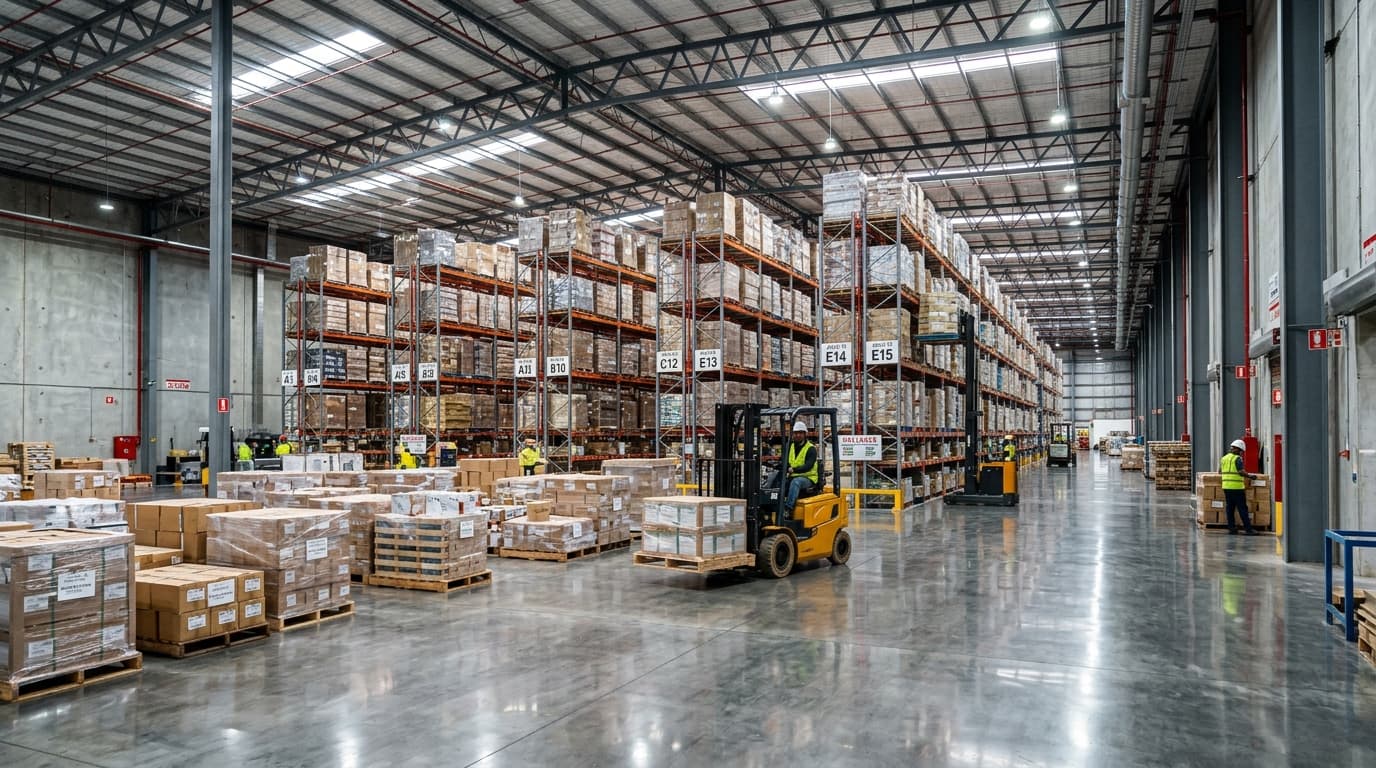
With major logistics developments expanding across Narayanganj BSCIC, Gazipur, Savar, and the Dhaka-Chattogram highway corridor, warehouse floors must withstand unrelenting 6-ton to 10-ton axle forklift loads, high rack point pressures, and continuous pallet jack dragging.
When designing a 50,000 to 200,000 sq ft logistics hub, choosing the wrong surface treatment leads to massive concrete dusting, rutted traffic aisles, and continuous inventory damage.
2. What is Monolithic Dry-Shake Floor Hardener?
Dry-shake hardener is a factory-blended mixture of graded quartz or synthetic mineral corundum aggregates, Portland cement, and plasticizing additives. It is broadcast directly onto the surface of freshly poured, power-troweled concrete at 4.0 to 6.0 kg/m² before the slab sets.
Because it hydrates together with the base slab, it forms a monolithic 3mm to 4mm ultra-dense wear layer. Unlike topical coatings, it is physically impossible for a dry-shake hardener to peel, blister, or delaminate from the concrete.
3. Direct Comparison: Hardener vs Epoxy Coating
Below is a head-to-head engineering comparison across key logistical operational parameters:
| Comparison Factor | Monolithic Dry-Shake Hardener | Epoxy Flooring System | Best Choice For |
|---|---|---|---|
| Timing of Installation | During fresh concrete casting only | 28 days after concrete casting | Hardener for new build; Epoxy for retrofit |
| Risk of Delamination | 0% (Fused monolithically with slab) | Low if primed; High if prep skipped | Hardener (Zero bond failure risk) |
| Abrasion Resistance | Extreme (Mohs Hardness 7 to 8) | High (Resilient polymer matrix) | Hardener for heavy dragging/forklifts |
| Chemical / Acid Resistance | Moderate (Stains under oils/acids) | Excellent (Impermeable barrier) | Epoxy for battery/chemical zones |
| Dust-Proofing | Good (Permanent with densifier) | 100% Complete dust-free seal | Epoxy for pharma/clean goods |
| Initial Investment Cost | BDT 45 – 85 / sq ft (Very low) | BDT 90 – 260 / sq ft | Hardener delivers highest ROI per sq ft |
Frequently Asked Questions
Can dry-shake hardener be applied to an existing 1-year-old concrete slab?
No. Dry-shake hardeners require bleed water from wet concrete to hydrate. For existing slabs, the proper treatment is mechanical diamond grinding followed by liquid lithium silicate densification or an epoxy coating.
Can an epoxy floor be applied over a floor hardener later?
Yes! If warehouse operations transition into cleanroom or pharmaceutical storage, the hardened slab can be diamond-ground to open surface pores and coated with self-leveling epoxy seamlessly.