Epoxy flooring is rock-hard, rigid, and has higher compressive strength (70-75 MPa), making it the superior, cost-effective choice for dry cleanrooms, garment factories, and showrooms. Polyurethane (PU) screed is flexible, impact-absorbing, and thermal-shock resistant (-40°C to +120°C), making it the mandatory choice for wet food processing plants, dairies, cold storage facilities, and chemical washdown bays.
Key Engineering Takeaways
- Epoxy cures to a rigid 70+ MPa finish with superior gloss, ideal for forklift traffic and dry pharmaceutical manufacturing.
- PU concrete screeds expand and contract with the concrete substrate under extreme hot/cold steam cycles, preventing delamination.
- PU topcoats are aliphatic and 100% UV-stable (will never yellow under direct sunlight), whereas standard aromatic epoxies chalk over time.
- PU screed is 25-40% more expensive than self-leveling epoxy initially, but indispensable where steam cleaning or organic food acids are present.
1. The Fundamental Polymer Difference
When designing or refurbishing an industrial production floor in Bangladesh, selecting between Epoxy resin and Polyurethane (PU) screed is one of the most critical structural decisions an engineering team faces.
While both systems belong to the thermosetting polymer family and replace porous concrete with a seamless, hygienic surface, their molecular cross-linking structures produce vastly different mechanical behaviors under stress, temperature shifts, and chemical contact.
2. Mechanical Strength & Impact Resistance
Epoxy achieves exceptionally high compressive strength—routinely between 70 MPa and 80 MPa (ASTM C579), which is roughly twice as strong as standard M30 structural concrete. This makes epoxy unmatched for static compressive loads, such as high-bay racking anchor points and hard nylon forklift wheels rolling over smooth surfaces.
However, epoxy's high rigidity is also its limitation: when subjected to severe point impact (e.g. dropping a 20kg steel casting or heavy die) or structural building movement, rigid epoxy can chip or crack.
Polyurethane possesses natural elastomeric flexibility with lower surface brittleness. When subjected to heavy dropped objects or constant floor vibration (such as next to heavy spinning frames or stamping presses), PU absorbs and dissipates the impact energy without shattering the bond.
3. Thermal Shock & Temperature Thresholds
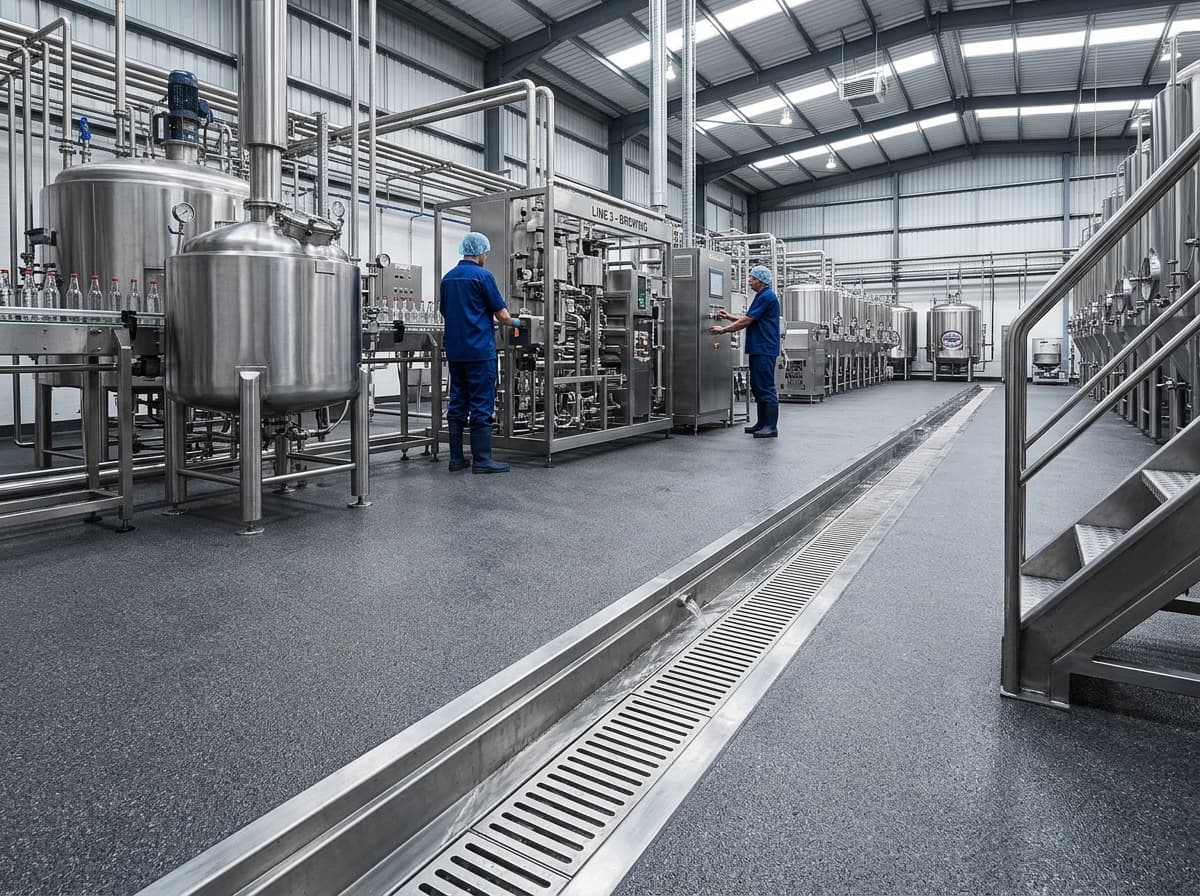
Thermal shock is the primary cause of coating debonding in food processing plants, beverage bottling lines, dairies, and industrial kitchens across Bangladesh.
Standard epoxy begins to soften at approximately 60°C and has a thermal expansion coefficient significantly different from concrete. When a live steam wand (100°C) washdown hits an epoxy floor in a cold room (10°C), the rapid localized expansion causes the epoxy to shear off the concrete substrate.
Polyurethane concrete screeds (4mm to 9mm) are engineered specifically to match the thermal expansion coefficient of concrete. A 6mm PU screed easily endures constant temperatures from -25°C to +100°C, while a 9mm screed withstands live steam washdowns up to +120°C without blistering or delaminating.
| Performance Metric | Self-Leveling Epoxy (2-4mm) | Industrial PU Screed (4-9mm) | Winner / Recommended |
|---|---|---|---|
| Compressive Strength | 70 – 80 MPa | 50 – 60 MPa | Epoxy (Rigid point loads) |
| Thermal Shock Tolerance | Max 60°C (Not steam safe) | -40°C to +120°C | PU Screed (Food & Beverage) |
| UV Sunlight Stability | Prone to yellowing/ambering | 100% Aliphatic UV Stable | PU (Outdoor/Atrium decks) |
| Chemical Resistance (Organic) | Good against fuels/alkalis | Superior against lactic/citric acids | PU (Dairies & Meat plants) |
| Relative Cost per Sq Ft | BDT 260 – 350 / sq ft | BDT 380 – 550 / sq ft | Epoxy (More economical) |
4. Practical Decision Framework for Bangladesh Industries
Choose Epoxy Flooring If Your Facility Is: A garment spinning, knitting, or sewing floor in Gazipur or Savar; a dry pharmaceutical cleanroom (Grade B, C, D); an automotive showroom or assembly plant in Tejgaon; or an electronics testing lab.
Choose Polyurethane (PU) Screed If Your Facility Is: A dairy, poultry, fish processing, or beverage plant in Narayanganj or Munshiganj; a deep freezer cold storage complex operating below 0°C; a commercial kitchen; or an open-air rooftop deck exposed to tropical UV rays.
Frequently Asked Questions
Can I apply PU flooring directly over an existing epoxy floor?
No. PU screed requires aggressive mechanical profiling (CSP-4) and mechanical anchor grooves cut into concrete. Old epoxy must be completely removed by planetary diamond grinding or scarifying first.
Will epoxy yellow near windows or factory skylights?
Yes, standard aromatic epoxy resin yellows when exposed to UV rays. To prevent this, KB Flooring BD applies a clear aliphatic polyurethane topcoat over the epoxy to provide permanent UV protection.