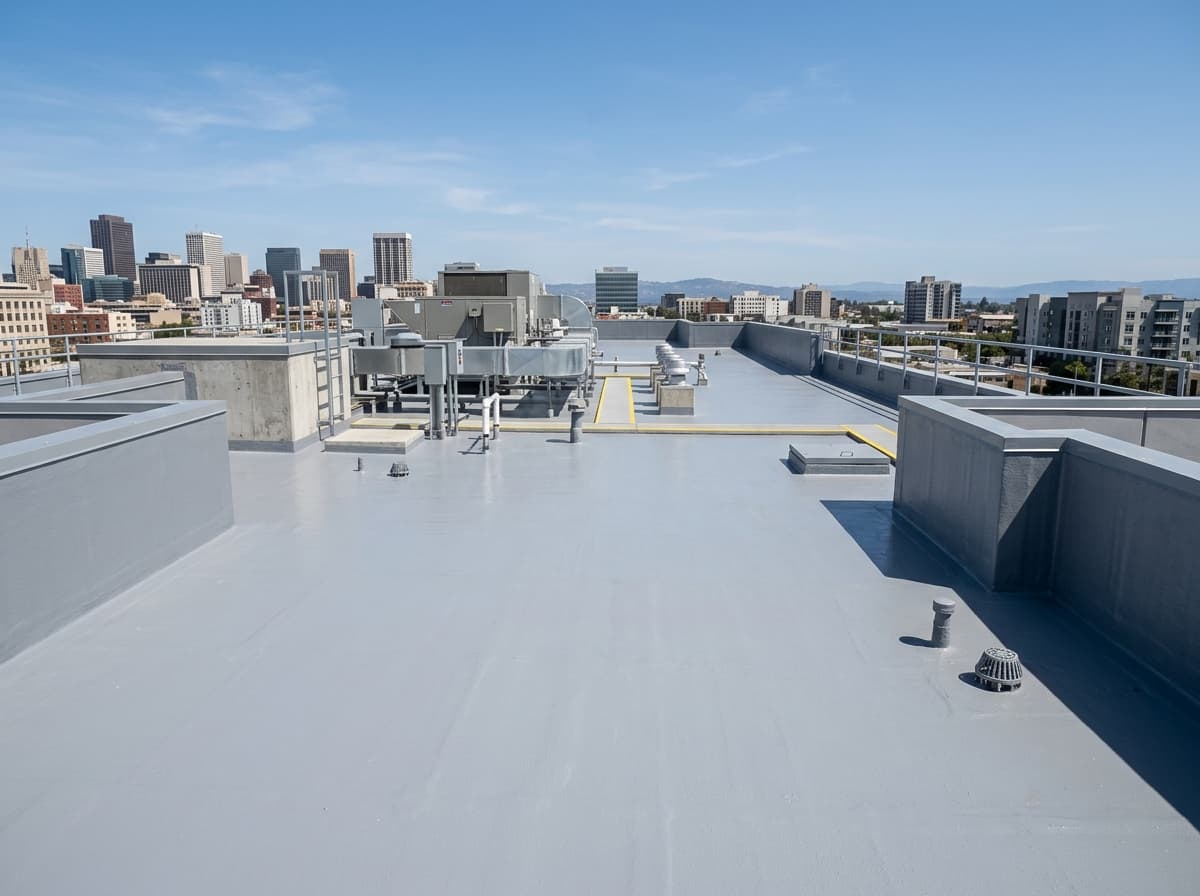
Permanent roof waterproofing in Bangladesh requires a 5-step engineered approach: 1) Verify slab drainage slope (minimum 1:100) to eliminate water ponding, 2) V-cut all cracks and form 45° polymer mortar fillets along parapets, 3) Apply a moisture-tolerant deep penetrating primer, 4) Apply two cross coats of liquid elastomeric polyurethane membrane with geotextile mesh reinforcement (>400% elongation), and 5) Top with an aliphatic UV-reflective cool roof topcoat (SRI > 100).
Key Engineering Takeaways
- Traditional bitumen tar-felts and unreinforced paints crack within 1-2 years due to extreme concrete thermal expansion cycles in Bangladesh.
- Eliminating standing ponding water via slope correction is step #1 before applying any chemical waterproofing membrane.
- Liquid-applied polyurethane elastomeric membranes provide joint-free, continuous protection with over 400% elongation bridging dynamic building cracks.
- High Solar Reflectance Index (SRI) topcoats not only protect the membrane from UV degradation but reduce interior room heat by 4°C to 6°C.
1. The Monsoon Challenge on Bangladesh Flat Concrete Roofs
Commercial skyscrapers in Gulshan and Motijheel, multi-story garment factories in Ashulia, and residential terraces across Dhaka endure severe tropical weather. During the monsoon season (June to September), rooftops receive thousands of millimeters of rain within short bursts.
Compounding the rainfall is intense tropical solar radiation reaching 38°C to 40°C on roof surfaces. This causes extreme thermal shock: concrete slabs expand significantly in the midday sun and contract rapidly during heavy night downpours.
Rigid waterproofing membranes, thin cement slurries, and traditional bitumen tar-felts cannot withstand this continuous thermal movement. Within one or two seasons, they tear, debond, and allow water to seep through micro-cracks into ceiling slabs and corrosion-prone rebar.
2. The 5-Step Engineered Liquid Polyurethane Protocol
KB Flooring BD follows a strict 5-stage waterproofing execution methodology compliant with international ASTM standards:
Step 1 - Substrate Cleaning & Slope Rectification: Pressure-wash the slab at 250 bar to remove algae, dirt, and weak concrete laitance. Slabs must have a continuous minimum slope of 1:100 toward drainage spouts. Any sunken water-ponding depressions must be leveled with polymer-modified repair mortar.
Step 2 - Crack V-Cutting & 45-Degree Parapet Coving: Water leaks almost always initiate at 90-degree parapet wall junctions and cold construction joints. All cracks are diamond-blade V-cut and filled with high-modulus polyurethane sealant. All wall-to-floor corners receive a 75mm x 75mm radius coving fillet.
Step 3 - Moisture-Tolerant Penetrating Primer: Concrete retains residual dampness. A specialized polyurethane primer penetrates deep into concrete capillaries, sealing rising vapor and forming a chemical bond exceeding 2.5 MPa.
Step 4 - Dual-Coat Liquid Polyurethane with Geotextile Armor: Liquid elastomeric PU membrane is applied in two perpendicular cross coats to achieve a dry film thickness of 1.5mm to 2.0mm. A non-woven polyester geotextile fleece is embedded between coats over all joints, drains, and HVAC mounting pads.
Step 5 - Aliphatic UV-Shield Cool Roof Topcoat: An aliphatic UV-stable topcoat with a Solar Reflectance Index (SRI) above 100 is applied. This reflects 85% of solar heat and shields the elastomeric membrane from solar degradation.
3. Bitumen Felts vs Liquid Polyurethane: Durability Comparison
Many contractors still offer traditional torch-applied bitumen rolls. The table below illustrates why modern commercial developers across Dhaka are transitioning exclusively to liquid polyurethane membranes:
| Comparison Parameter | Traditional Bitumen Felt Roll | Liquid Elastomeric PU Membrane | Engineering Advantage |
|---|---|---|---|
| Monolithic Joint-Free Surface | No (Overlaps fail every 1m) | Yes (100% monolithic seamless) | PU Membrane (Zero joint leaks) |
| Elongation at Break | 10% – 25% (Brittle in winter) | > 400% (ASTM D412) | PU Membrane (Bridges dynamic cracks) |
| Ponding Water Resistance | Poor (Softens under standing water) | Complete (Continuous immersion safe) | PU Membrane (Handles flat ponding) |
| UV Weathering Lifespan | 2 to 3 years before cracking | 10 to 15 years with UV shield | PU Membrane (5x longer lifespan) |
| Written Stamped Warranty | Usually 1 year verbal | 10-Year Stamped Written Warranty | KB Flooring BD Guarantee |
Frequently Asked Questions
Can liquid PU waterproofing be applied if it rained yesterday?
Yes, provided the concrete surface is surface-dry and our technicians verify that residual slab moisture is within primer tolerance using electronic moisture meters.
Can we walk on the roof or use it as a garden terrace after waterproofing?
Yes! KB Flooring BD applies pedestrian wear-resistant aliphatic topcoats or drainage protection sheets suitable for roof gardens, solar panel arrays, and outdoor seating.