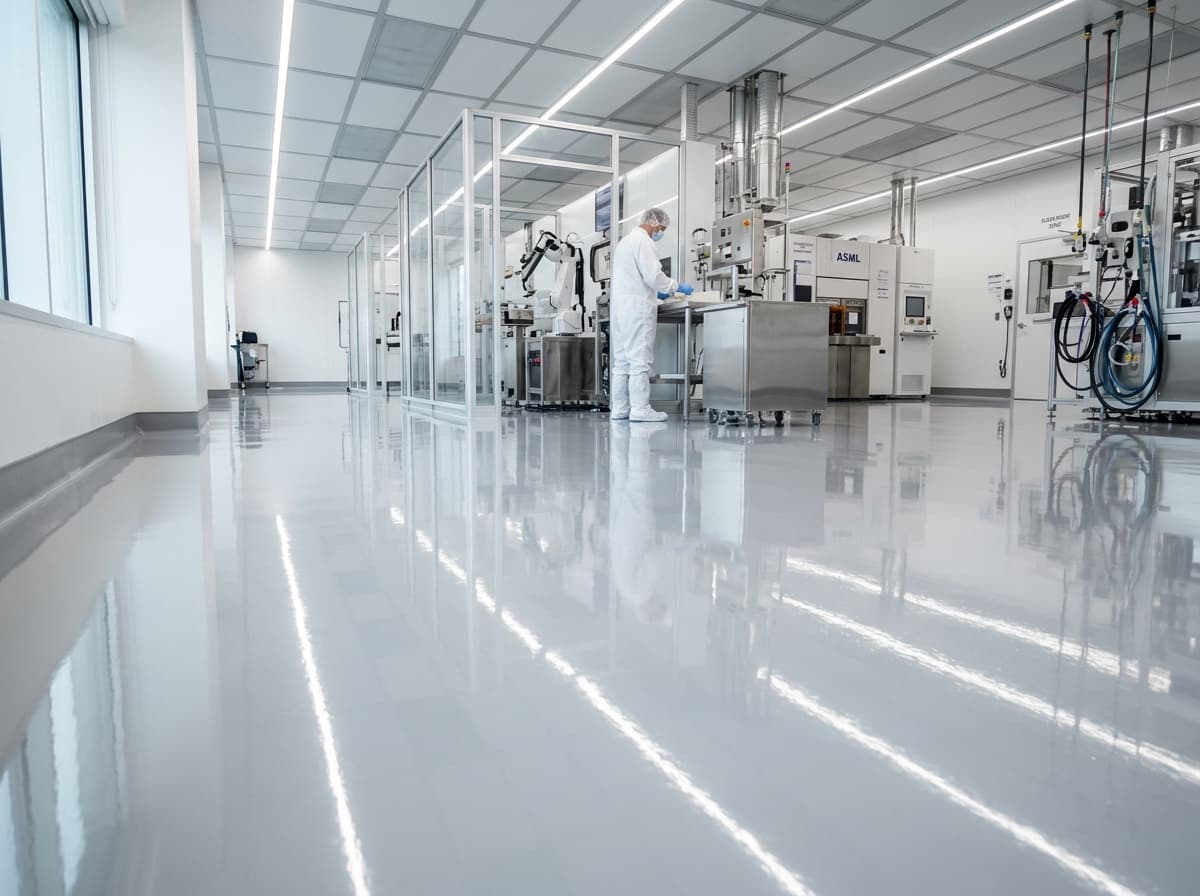
In Bangladesh, professional industrial epoxy flooring costs between BDT 90 and BDT 420 per square foot depending on the system thickness and slab condition. Thin roller coatings (300-500 microns) average BDT 90 – 140/sq ft, multi-layer systems (1mm-2mm) range from BDT 160 – 250/sq ft, while heavy-duty self-leveling cleanroom epoxy (2mm-4mm) costs BDT 260 – 420/sq ft including planetary diamond grinding surface preparation.
Key Engineering Takeaways
- Substrate preparation (planetary diamond grinding to CSP-3) accounts for roughly 15-20% of project cost but prevents 90% of coating failures.
- Solvent-free 100% solids epoxy resins cost more initially than solvent-thinned paints but provide 3x longer operational lifespan under forklift traffic.
- Concrete moisture above 4% requires an epoxy moisture vapor barrier primer, adding approximately BDT 35 – 55 per sq ft to base estimates.
- Greater Dhaka, Gazipur, Savar, and Narayanganj benefit from standard local mobilization, whereas remote divisions include transport allowances.
1. Overview of Epoxy Flooring Rates in Bangladesh
As industrial manufacturing across Greater Dhaka, Gazipur, Savar EPZ, and Narayanganj continues to modernize under international compliance frameworks (RMG Accord, cGMP, and ISO standards), high-performance epoxy flooring has shifted from a luxury finish to a mandatory industrial standard.
Facility managers frequently ask: 'What is the genuine cost per square foot for epoxy flooring in Bangladesh?' The marketplace presents vast pricing discrepancies—ranging from local painters offering enamel coats at BDT 50/sq ft to certified engineering contractors quoting BDT 350/sq ft. Understanding what you are paying for is the single most critical factor in avoiding catastrophic floor delamination within 6 months.
A legitimate industrial epoxy flooring system is not mere paint from a tin; it is a multi-component chemical thermosetting polymer engineered to withstand dynamic wheel loads, high impact, caustic chemical spills, and heavy abrasion.
2. Comprehensive Cost Per Square Foot Matrix by System Type
The primary determinant of epoxy pricing is the system build thickness, resin solid content, and required mechanical durability. Below is the verified standard price benchmark across Greater Dhaka and national industrial zones for 2026:
| System Classification | Nominal Thickness | Estimated Cost (BDT / Sq Ft) | Recommended Applications |
|---|---|---|---|
| Dust-Proof Epoxy Roller Coating | 300 – 500 microns | BDT 90 – 140 | Light assembly, multi-level car parks, packaging storage |
| Intermediate Multi-Coat Epoxy | 1.0mm – 1.8mm | BDT 160 – 250 | Garment finishing halls, light automotive workshops, showrooms |
| Heavy-Duty Self-Leveling Epoxy | 2.0mm – 3.0mm | BDT 260 – 350 | Pharma cleanrooms (Grade C/D), spinning mills, heavy traffic |
| High-Build Cleanroom / ESD Epoxy | 3.0mm – 4.0mm | BDT 360 – 450 | Pharma Grade A/B, electronics assembly, battery rooms |
| Heavy Duty Industrial PU Screed | 4.0mm – 6.0mm | BDT 380 – 550 | Food & beverage processing, steam washrooms, cold storage |
3. Hidden Variables That Impact Final Quotations
A transparent engineering quote must account for site-specific substrate variables. When KB Flooring BD conducts a complimentary site inspection in Dhaka, we evaluate five critical cost drivers:
A. Existing Concrete Slab Condition: New slabs with a sound power-troweled finish require standard diamond grinding. Conversely, deteriorated older concrete with spalling, oil saturation, or deep cracks requires structural micro-concrete patching and high-tensile epoxy injection, which adds BDT 20 – 40/sq ft.
B. Substrate Moisture Vapor Transmission: Bangladesh's high riverine water table frequently leads to moisture trapped in lower concrete pores. If slab relative humidity exceeds 4% (tested via in-situ Tramex or moisture impedance meters), applying standard epoxy will cause osmotic blistering. An engineered moisture barrier primer must be applied, adding BDT 35 – 55/sq ft.
C. Total Project Area (Economies of Scale): Mobilizing heavy 3-phase planetary grinders, generator power, and technical crews creates fixed overheads. Projects exceeding 20,000 sq ft enjoy significantly lower unit rates compared to compact 2,000 sq ft boutique spaces.
D. Working Hours & Shift Constraints: Continuous night-shift installations inside active production cleanrooms require specialized staging, air extraction, and shift premiums.
4. Why Cheap 'Epoxy Paint' Costs 3x More in the Long Run
Contractors offering BDT 50 – 70 per sq ft typically apply solvent-diluted enamel or thin floor paints without surface grinding. Over 90% of such floors fail within 3 to 6 months through tyre peeling, blister formation, and micro-cracking.
When a substandard floor fails in an active factory, the cost to strip the failed coating, re-grind the damaged concrete, and lay a proper self-leveling system while shutting down production lines is three to four times the original installation cost.
Investing in an ASTM-tested, solvent-free epoxy system backed by a 5-to-10-year written warranty guarantees unbroken manufacturing operations and minimal facility lifecycle maintenance.
Frequently Asked Questions
How long does a 2mm self-leveling epoxy floor last in an active Bangladesh factory?
When installed over properly diamond-ground concrete with a moisture barrier primer, a 2mm self-leveling epoxy floor easily lasts 7 to 10 years under continuous forklift and pedestrian transit before requiring a light recoat.
Does the cost per sq ft include diamond surface grinding?
Yes, at KB Flooring BD, all formal technical quotations include mechanical planetary diamond grinding (CSP-3 profile), vacuum dust extraction, crack V-cutting, and epoxy primer saturation.
What is the typical lead time for a 10,000 sq ft epoxy installation?
A 10,000 sq ft self-leveling project typically takes 4 to 5 working days from initial surface grinding to topcoat application. Light foot traffic is permitted after 24 hours of curing.